Cold-chain performance modeling with real thermal data
In temperature-controlled logistics, it is necessary to be able to predict how a packaging system behaves under realistic conditions. External temperatures vary widely by season, route and means of transportation, making it difficult to generalize the thermal stress on refrigerants and insulation materials. Models based on theoretical assumptions often lack the accuracy needed for pharmaceuticals, perishable foods and other temperature-sensitive goods. Therefore, more and more organizations are using real thermal data from data logging, climate chamber tests and shipping-lane profiles to calculate and validate cold-chain performance. This data makes it possible to analyze temperature behavior, identify risks in advance and match the configuration of refrigerants and packaging to actual supply chain conditions.
Customization for your unique challenge
Choose solutions that fully meet your needs. At Coolpack, we’re ready with innovative and reliable products for conditioned transport. Together we will be happy to discuss what works for you. Discover what’s possible. Click below for more information.
Specialist in the market
For conditioned transport
Always a solution
Perfectly tailored to your situation
Fast delivery
Your products safe and fresh
Trusted quality
Known to perform time and again
Thermal fundamentals in the cold chain
Latent heat and phase transitions
At the heart of any cold-chain simulation is the phase transition of refrigerants. The amount of latent heat determines how long a refrigerant can absorb energy without increasing temperature. Water-based refrigerants have a transition around 0 degrees Celsius, while PCMs are designed for precise temperature bands such as 2 to 8 degrees or deeper frozen ranges. Models use these values as fixed inputs because a deviation in melting point directly affects the internal temperature curve of the package.
Thermal conductivity and insulation
Thermal models link conductivity, specific heat and thickness of the insulation material to the expected heat flux. Monomaterial insulations, EPS, EPP or combinations thereof each have a specific heat behavior. Pre-calculations describe how quickly heat enters the packing chamber through walls or openings. This partly determines how much refrigerant mass is needed to pass a given profile.
Real thermal data as basis for modeling
Shipping-lane profiles
Many models start with data loggers that are deployed in field transports. The measured outdoor temperatures are translated into profile curves with fluctuations that correspond to real-world conditions such as dock times, aircraft spaces, urban distribution or nighttime cooling. Shipping-lane data prevents underestimation of temperature extremes and provides a solid basis for simulation.
Climate chamber tests
Where shipping-lane data gives a realistic pattern, the climate chamber provides reproducibility. By testing a package with refrigerants in a controlled profile, it is possible to determine how the internal temperature responds. The measured melting curve is then used to calibrate numerical models. Without this coupling, simulations can predict anomalous behavior, especially for PCMs that rely heavily on precise phase transition parameters.
Modeling temperature behavior in packaging
Numerical simulation
Computational modeling, often based on heat transfer equations, makes it possible to calculate scenarios. This combines mass, conductivity, latent heat, geometry and insulation values. The simulation calculates how fast a refrigerant melts and how the temperature spreads through the package. This is especially relevant for products stored in sensitivity zones, such as vaccines or refrigerated foods.
Comparison with experimental data
A model becomes reliable only when it has been compared with data from climate chamber tests or field measurements. Small deviations in melting behavior, wall conductivity or heat leaks become visible as a result. This validation step ensures that simulations are useful for design decisions, such as the choice of PCMs, the required refrigerant mass or the optimal placement of packs.
Practical application for businesses
Risk analysis and configuration
With real thermal data, organizations can quantify risk. For example, it is possible to calculate the margin available for extremely hot or cold routes. The configuration of refrigerants can be adjusted by varying mass, melting point, placement or packaging type. This reduces the likelihood of temperatures falling outside the allowable band.
Validation and periodic reassessment
Modeling supports validation processes for transports in regulated industries. Combining data and simulation creates a reproducible method for proving that a package meets temperature criteria. With changes in routes, seasons or packaging materials, the cold chain can be recalculated and tested again to avoid anomalies.
How Coolpack’s thermal specifications connect to data-driven cold-chain modeling
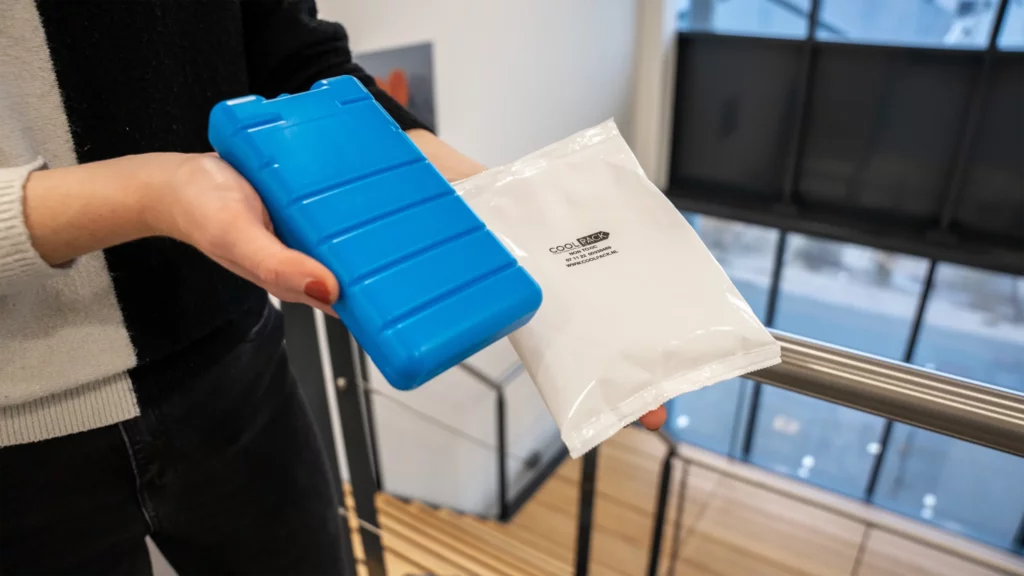
Modeling cold-chain performance with real thermal data aligns with the way Coolpack develops and applies cooling solutions. For cooling elements, gel packs and PCM solutions, thermal properties such as melting point, heat storage and filling technique are precisely specified. These parameters form the basis for predictable temperature curves when used in temperature-controlled logistics. The combination of consistent production quality, specific PCM configurations and suitable insulation solutions makes it possible to tailor packaging to realistic temperature profiles. Organizations looking to improve their temperature control can use technical product data and thermal measurement results to optimize configurations. For substantive questions about applications or product selection, we are happy to think along with you.
Sustainability Coolpack and CSR
At Coolpack, we are aware of our responsibility to contribute to society. Both in terms of sustainability and society as a social body.
We weigh the interests of the customer, the environment and society, as well as ourselves as an organization, in all business decisions. In this way, we achieve balanced business operations and together ensure an ever better world.
Product groups
Customer Cases
Contact
- +31 (0)33 457 19 82
- info@coolpack.nl
-
Industrieweg 11b
1566 JN Assendelft
Related blogs
In the ever-changing landscape of cold chain logistics, maintaining accurate temperature control is crucial. This can be achieved with Phase […]
The growing importance of clinical trial logisticsThe clinical trial market is experiencing unprecedented growth, driven by factors such as the […]